
For commercial roof repair Houston that owners can trust, certifications come first. A qualified roofer should hold manufacturer certification from brands like Versico, Carlisle, or GAF. They should also carry general liability and workers’ comp insurance. In addition, look for bonding, OSHA safety training, and proper permits. Texas has no statewide roofing license, so these credentials matter even more.
When you search “commercial roof repair Houston,” dozens of names appear. Yet only a few have the training your building truly needs.
Houston roofs take a beating every year. Gulf Coast humidity, intense UV, and summer heat age membranes fast. Then hurricane season and hail season add sudden damage on top.
As a result, picking the wrong Houston roofing company costs more than money. It can void warranties, delay repairs, and disrupt your tenants.
This guide gives you 12 questions to ask before you sign. It covers TPO roofing, coatings, maintenance & repair plans, and warning signs. In short, it helps you hire for commercial roofing in Houston TX with confidence.
The right contractor protects your roof, your warranty, and your operations. The wrong one can quietly put all three at risk.
After a major storm, out-of-town crews often flood Harris County. Many knock on doors, collect deposits, and leave before problems surface. Consequently, owners are left with poor repairs and nobody to call.
Warranty loss is another hidden risk. Most manufacturers only honor warranties when certified installers do the work. So an uncertified patch can void years of coverage.
Downtime matters too. A leak over a medical office or restaurant can close the doors for days. Therefore, response speed and workmanship directly affect your revenue.
Geography adds another layer. Buildings in Pasadena and League City face salty coastal air. Meanwhile, properties in Katy, Cypress, and Sugar Land see frequent hail and wind events.
Houston tip: Vet contractors before June. Once hurricane season starts, trusted crews fill their schedules quickly.
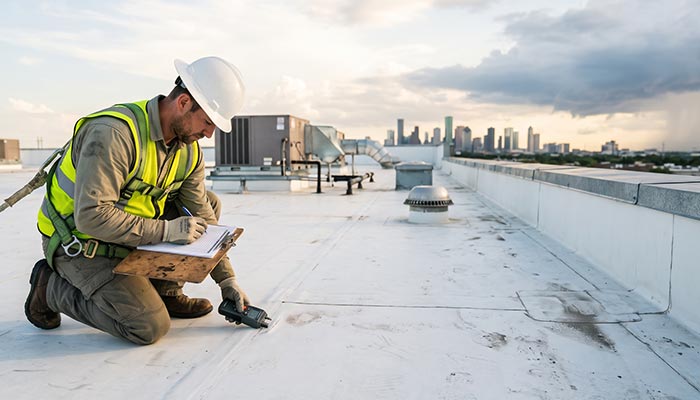
These questions separate trained commercial roofers from general handymen. Ask each one, and request written proof whenever possible.
Texas has no statewide roofing contractor license. Because of this, manufacturer certification is one of your best quality signals.
Brands like Versico, Carlisle, and GAF train and inspect their certified contractors. In addition, only certified installers can usually offer NDL warranties. NDL means “no dollar limit,” and it covers both materials and labor.
Voluntary credentials help too. Membership in RCAT or NRCA shows a commitment to training and industry standards. Meanwhile, OSHA fall protection training shows the crew takes safety seriously on your property.
What a good answer sounds like: “Yes, we’re certified with that manufacturer. Here is our current certificate.”
Roof work is risky, and accidents happen. If an uninsured worker gets hurt, liability could fall on you.
Ask for certificates of insurance sent directly from the agent. Also, confirm the policy dates and coverage match your project.
What a good answer sounds like: “Our agent will send certificates naming you as the certificate holder today.”
Bonding protects you financially if a contractor fails to finish the job. Many schools, churches, and public buildings require it.
Permits matter just as much. The City of Houston requires permits for many roof projects. Likewise, coastal jobs near League City may need a Texas Department of Insurance windstorm inspection.
What a good answer sounds like: “We’re bondable, and we handle permits and any required inspections.”
Commercial roofs differ greatly from residential ones. Low-slope systems, drains, and rooftop units need specific skills.
Local experience matters, too. A Houston crew understands ponding after heavy rain and summer heat on membranes. They also know how coastal air affects metal and flashing.
Building type matters as well. A medical office building needs quiet, clean work around patients. Meanwhile, a retail center needs crews who protect storefronts and shopper traffic.
What a good answer sounds like: “We’ve worked on Houston commercial roofs for years. Here are similar local projects.”
Each roof system needs different materials and techniques. For instance, TPO roof repair uses heat-welded seams. By contrast, EPDM roof repair often relies on adhesives and tapes.
PVC roof repair, modified bitumen repair, and metal roof repair each follow their own methods. A contractor who knows only one system may patch others incorrectly.
What a good answer sounds like: “We repair all major low-slope systems and match each repair to your existing roof.”
Leaks rarely wait for business hours. Hurricane roof damage in Houston often arrives at night or on weekends.
Ask whether the company offers emergency tarping or temporary covers. Moreover, ask how they prioritize existing clients after a major storm.
Fast response protects more than the roof. For example, water can ruin inventory in warehouses and flex space. It can also damage ceilings and flooring in schools or churches.
What a good answer sounds like: “Yes, we offer emergency response and temporary covers to stop water fast.”
Houston tip: Photograph your roof before hurricane season. These baseline images can support insurance claims later.
Water on a flat roof can travel far before it drips inside. So the visible stain rarely marks the real entry point.
Skilled roofers use infrared scans, moisture surveys, and core cuts. A core cut is a small sample that reveals wet insulation below the membrane.
What a good answer sounds like: “We use moisture detection tools, so we fix the source, not just the symptom.”
Houston tip: Check your roof after heavy rain. Water that sits for days often points to drainage problems.
Some contractors push full replacement every time. However, many roofs only need targeted flat roof repair.
A trustworthy roofer explains the condition, the options, and the trade-offs. Furthermore, they back their advice with photos and moisture data.
What a good answer sounds like: “Here are our photos and findings. Repair makes sense now, and here’s when to plan replacement.”
A silicone roof coating can extend the life of a sound roof. It reflects heat, which helps buildings handle Houston’s intense UV.
Still, coatings are not a fix for every roof. Wet insulation or failing seams must be repaired first. In addition, the surface needs careful cleaning so the coating bonds well.
What a good answer sounds like: “We’ll test the roof first. If it qualifies, a coating may be a smart option.”
Two warranties usually apply. The manufacturer covers materials, while the contractor covers workmanship.
Ask for both in writing. Additionally, check whether outside repairs could affect your existing roof warranty.
What a good answer sounds like: “Here is our written workmanship warranty. We’ll also explain how it works with your manufacturer warranty.”
Most major roof failures start as small, ignored problems. Clogged drains, open seams, and loose flashing worsen over time.
A maintenance & repair program schedules regular inspections. As a result, minor issues get fixed before they become leaks. This approach suits office parks, retail centers, and multifamily properties especially well.
What a good answer sounds like: “Yes, we offer scheduled inspections with photo reports after each visit.”
Houston tip: Book inspections in spring and again after hurricane season ends.
A warehouse roof differs from a church or school roof. Therefore, ask for references from similar building types.
Call those references directly. Ask about communication, cleanup, timelines, and how problems were handled.
If you manage an HOA clubhouse or multifamily property, ask how the crew handled residents. Good contractors plan around parking, noise, and access.
What a good answer sounds like: “Here are recent clients with buildings like yours in your area.”
Some warning signs show up early. If you notice any of these, slow down and keep looking.
Houston tip: Confirm the contractor’s name matches their insurance certificate and business registration.
TPO roof cost in Houston depends on your building, not a flat rate. These factors shape every quote.
Because of these variables, always request an on-site inspection before comparing quotes. Also, make sure each quote describes the same scope. Otherwise, you may compare very different projects without realizing it.
Houston tip: Ask whether quotes meet FM Global or UL wind ratings if your insurer requires them.
Marlin Construction LLC has focused on commercial roofing since 2004. Over two decades, our crews have installed more than five million square feet of TPO and PVC.
Our technicians are factory-trained. We have also earned the Versico Gold Medal Quality Award eight years in a row. In addition, we are fully insured and bondable.
We repair and maintain TPO, PVC, EPDM, modified bitumen, metal, and coated roofs. Our services also include inspections, roof consulting, insurance claim support, and temporary covers.
Based in North Houston near 77086, we serve Houston, The Woodlands, Spring, and League City. Owner John Josephs leads the company, and emergency service is available around the clock.
Coat or replace? How Houston businesses add 10–20 years to rusting metal roofs

How to choose a commercial roofing contractor in Houston: 12 questions to ask (and red flags)
Aging TPO roof after storm season? How Houston building owners restore instead of replace

Coat or replace? 7 signs your Houston flat roof is a candidate for silicone restoration

Is your Houston TPO roof hurricane-ready? Wind uplift, FM ratings and the 2026 Texas windstorm code explained

7 Signs Your Houston Commercial Roof Needs a Coating (Not a Replacement)

TPO vs PVC vs silicone coating: Which flat roof costs less long-term in Houston?
Texas has no statewide roofing license, so look for manufacturer certification from brands like Versico, Carlisle, or GAF. Also confirm general liability and workers’ comp insurance, bonding, and OSHA training. Membership in RCAT or NRCA is another good sign when choosing commercial roofing in Houston TX.
No. Texas does not issue a statewide roofing contractor license. However, cities like Houston require permits for many roof projects. Because licensing is absent, you should verify insurance, bonding, and manufacturer certification yourself before hiring any Houston roofing company for commercial repair work.
A TPO roof often needs repair when damage is limited to seams, flashing, or small punctures. Replacement becomes likely when insulation is widely wet, or the membrane turns brittle. A moisture survey helps you decide. Before choosing, ask your TPO roofing contractor for clear photos and written findings.
TPO roof cost in Houston depends on roof size, membrane thickness, insulation condition, access, drainage, and rooftop equipment. Warranty level and old layer removal also matter. Because every building differs, an on-site inspection is the only reliable way to get an accurate quote for your property.
Silicone roof coating in Houston can work well on a roof that is structurally sound and mostly dry. It reflects heat and resists ponding water. However, it cannot fix wet insulation or failed seams. A qualified local contractor should test the roof first to confirm it is a good candidate for coating.
Most Houston commercial roofs should be inspected twice a year, ideally in spring and fall. You should also schedule an inspection after any major hail or hurricane event. A maintenance & repair program makes this easy. It also helps catch small issues early, before they turn into costly interior leaks.
First, keep people safe and away from leaking areas. Next, photograph the damage inside and out. Then call a local contractor for emergency commercial roof repair or temporary covers. Finally, contact your insurer promptly and keep every report, photo, and invoice together in one place for your claim records.
Storm chasers often knock on doors after big storms, push you to sign quickly, and lack a local address. Some offer to waive your insurance deductible, which Texas law prohibits. Instead, choose a Houston roofing company with a verifiable local office, proper insurance, and proven commercial references.
Temporary repairs and emergency covers can often go on during light rain to limit water damage. However, permanent repairs on TPO, PVC, or EPDM need dry surfaces for proper adhesion and welding. As a result, most experienced crews return once the roof dries to complete a lasting commercial roof leak repair.
Choosing the right contractor protects your building for years. Start with certifications, insurance, and local experience. Then ask about TPO roofing skills, silicone roof coating options, and maintenance & repair plans.
Above all, watch for red flags like pressure tactics and vague scopes. A careful choice today makes commercial roof repair in Houston far simpler tomorrow. Better still, it gives you a partner you can call when the next storm arrives.
If you’re weighing your options, a clear inspection is the best first step. Call Marlin Construction LLC at (713) 444-5202 to schedule a visit. As a local Houston roofing company, we’ll explain what we find and help you plan your next move.







10403 Kansack Lane
Houston, TX 77086
Call: (713) 444-5202
Hours of Operation
Monday – Saturday
7:00am – 6:00pm
Sunday – Closed
