
TPO Seam Repair in Houston often starts with a small clue after a storm. A brown stain spreads across a ceiling tile, yet the roof looks fine from the ground. On a flat roof, a failing seam is often the cause.
So, how do you know if your TPO roof seams are failing? Look for lifted or curled edges and laps that open under a probe. Also watch for wrinkles, fishmouths, ponding near seams, and interior stains after rain. A trained technician can confirm the damage with a seam probe test.
This guide comes from Marlin Construction, LLC, a commercial TPO roofing contractor serving Houston since 2004. It explains why seams fail here and what the warning signs look like. In addition, it covers repairs that last and simple TPO roof maintenance in Houston.
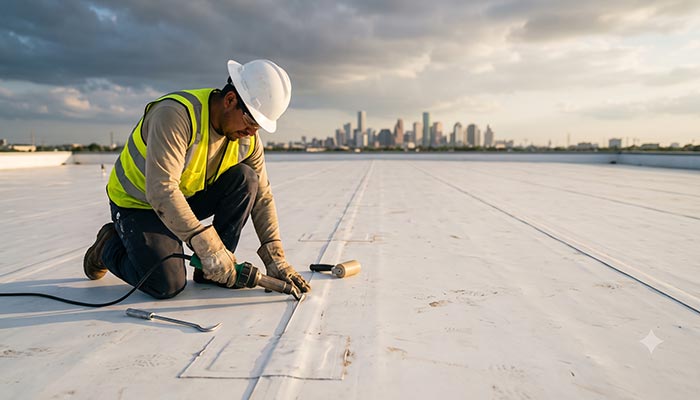
TPO seams fail in Houston because heat, UV, humidity, and storms stress the welded laps every year. Over time, the membrane weathers and moves. Meanwhile, wind uplift and hail add sudden loads. Eventually, a weak or aging weld opens and lets water in.
TPO sheets are joined by overlapping their edges and fusing them with hot air. This process is called hot-air welding. When done correctly, the two sheets become one continuous waterproof layer.
Most field seams are welded with a robotic welder. It travels along the lap at a steady speed and temperature. By contrast, hand welders handle corners, flashings, and tight details. Each manufacturer sets its own minimum lap and weld width.
Not every failure is weather-related, though. Some seams were never fully welded during installation. These cold welds look fine at first but separate within a few seasons.
Failing TPO seams usually show lifting edges, open laps, wrinkles or exposed reinforcement along the weld line. Inside, look for stains and drips after rain. Because early signs are subtle, a professional seam probe test gives the clearest answer.
Safety matters here. Avoid walking on a wet or storm-damaged roof. Instead, note the interior signs and call a TPO roofing contractor in Houston for a closer look. Early TPO seam separation repair is usually simpler than fixing the water damage that follows.
A commercial TPO roofing contractor inspects seams by walking every lap, probing each weld, and checking for hidden moisture. Findings are then documented with photos. This step matters because the leak inside is often far from the actual seam failure.
Every commercial TPO roof repair in Houston should start with this process:
At Marlin Roof Systems, factory-trained, in-house technicians handle these checks. As a result, owners work with one accountable team from inspection through repair.
The most durable TPO seam repairs re-weld or patch the membrane with compatible TPO, following manufacturer specs. Thorough cleaning always comes first. Sealants and tapes alone rarely hold up on Houston roofs. When damage is widespread, replacement may be the smarter long-term choice.
Aged TPO develops an oxidized surface layer. Before any weld, technicians scrub it with a manufacturer-approved membrane cleaner. Without this step, new welds may not bond fully.
For minor separation, crews clean the lap, dry it, and weld it again with hot air. Afterward, they probe the seam to confirm a solid bond. Hot-air welded seam repair restores the roof’s original sealing method rather than masking the problem.
However, not all old TPO accepts new welds. A small test weld on the aged sheet shows whether fresh welds will hold.
Patch corners are rounded so the edges do not catch the wind. Each patch is then probed, just like a new seam.
In these cases, a new TPO roof installation in Houston can be a better investment than repeated repairs. Marlin’s team will explain the options so owners can plan with confidence.
The cost of TPO seam repair in Houston depends on damage extent, membrane age, and roof access. Wet insulation and emergency timing also play a role. Therefore, a professional inspection is the only reliable way to get an accurate estimate.
Key cost factors include:
Because every roof is different, Marlin offers a free roof inspection and estimate. That way, owners can make decisions based on clear facts.
DIY seam fixes, such as caulk, roofing cement, or generic tape, can void a manufacturer’s warranty. Most manufacturers require compatible materials and approved repair methods. Moreover, many sealants contaminate the membrane, making proper welds harder later.
As a Versico Gold Medal Quality Award recipient, Marlin follows manufacturer repair specifications. Consequently, owners keep their roof warranty protection intact.
After storm season, TPO roof maintenance in Houston should include a seam check, drain cleaning, and a debris sweep. Ideally, schedule inspections each spring and fall, plus after every major storm. Regular checks catch small seam issues before water reaches the interior.
Use this post-storm checklist:
For larger portfolios, a scheduled maintenance plan keeps records organized. In addition, it supports future warranty and insurance documentation.
Marlin Roof Systems is a Houston-based commercial roofing contractor with over two decades of low-slope experience. The team has installed more than 5,000,000 square feet of TPO and PVC. Additionally, Marlin has earned the Versico Gold Medal Quality Award eight years in a row.
Marlin’s office sits in North Houston, in ZIP code 77086. From there, crews serve Harris County and nearby communities, including Spring, Cypress, and The Woodlands. Service also reaches Katy, Sugar Land, Pasadena, and League City.
For TPO seam repair in Houston, TX, the process stays the same on every job. First, the crew inspects and probes each seam. Next, it cleans, then welds or patches to manufacturer specs. Finally, every repair is probed again and photographed for the owner’s records.
For commercial roofing in Houston TX, that local base means crews understand Gulf Coast weather firsthand. Likewise, it supports faster scheduling after storms.

TPO roof replacement in Houston, TX: 2026 cost, process and warranty guide

TPO Roof Repair vs. Replacement: 7 Signs Your Houston Commercial Roof Needs Help

TPO Roofing Cost in The Woodlands, TX (2026): What Commercial Property Owners Actually Pay

TPO Seam Repair in Houston: Signs, Costs & Fixes After Storm Season (2026 Guide)

TPO Roof Maintenance in Houston: The 2026 Checklist for Commercial Property Owners

Repair or replace? When your Houston TPO roof needs more than a patch

TPO roof replacement in Houston: 2026 cost, timeline and what to expect
Common signs include lifting seam edges, open laps, fishmouths, wrinkles, and ponding water near welds. Inside, watch for ceiling stains or drips after rain. Early failures can still look sealed, however. For that reason, a TPO roofing contractor in Houston should probe every seam and test each weld.
Often, yes. Weathered TPO must first be cleaned with an approved membrane cleaner to remove its oxidized layer. Next, a test weld shows whether new welds will bond. If the sheet is too degraded, other options make more sense. These include a cover strip, an overlay patch, or a complete roof replacement.
A properly cleaned and hot-air welded repair can last as long as the surrounding membrane. However, lifespan depends on membrane age, UV exposure, and maintenance. Regular TPO roof maintenance in Houston includes seasonal seam probing. As a result, new weak spots are caught before they turn into leaks.
Yes. Marlin Roof Systems provides 24/7 emergency service for active leaks and storm damage. For TPO roof leak repair in Houston, crews can install a temporary dry-in to stop water entry. Then, the team returns to complete a permanent, manufacturer-approved seam repair once roof conditions are safe again.
Coverage depends on your policy and the cause of damage. Wind and hail damage are often reviewed differently from age-related wear. Clear photos and a detailed inspection report help support a claim. Marlin’s roof consulting team can document storm damage to assist property owners with insurance claims.
A coating alone cannot reliably fix open or failed seams. First, the seams must be re-welded or patched with compatible TPO. After that, a coating may be applied as part of a broader restoration plan. A commercial TPO roofing contractor can tell you whether your roof is a good candidate for coating.
Ideally, schedule an inspection every spring and fall. In addition, inspect after hurricanes, tropical storms or hail events. Houston’s heat, UV, and humidity stress seams constantly. Routine TPO roof maintenance in Houston catches small seam issues early, before water reaches insulation or interiors.
Repair makes sense when seam damage is limited, and the membrane is still sound. On the other hand, widespread cold welds, wet insulation, or a heavily weathered sheet may call for replacement. A TPO roof installation in Houston can then deliver a new, fully welded system with renewed warranty coverage.
They can. Caulk, roofing cement, and generic tapes are usually not approved by TPO manufacturers. Some products even damage the membrane or block future welds. To protect your warranty, hire a TPO roofing contractor in Houston. Choose one that follows the manufacturer’s repair specifications for your system.
Marlin Roof Systems is based at 10403 Kansack Lane in North Houston. The team provides TPO roofing in Houston and across Harris County. Service also reaches nearby communities such as Spring, The Woodlands, Cypress, Katy, Sugar Land, Pasadena, and League City. Call (713) 444-5202 to confirm your location.
Failing seams are a leading source of flat roof leaks after Houston storms. Lifting laps, fishmouths, ponding, and interior stains are the key warning signs. Above all, lasting TPO seam repair in Houston depends on proper cleaning, hot-air welding, and manufacturer specs. Meanwhile, routine TPO roof maintenance in Houston keeps small seam issues from becoming major projects.
Ready for clear answers about your roof? Schedule a TPO seam inspection with Marlin Roof Systems, your commercial TPO roofing contractor in Houston. Visit us at 10403 Kansack Lane, Houston, TX 77086, or call (713) 444-5202. Emergency service is available 24/7.












10403 Kansack Lane
Houston, TX 77086
Call: (713) 444-5202
Hours of Operation
Monday – Saturday
7:00am – 6:00pm
Sunday – Closed
