
Houston roofs work harder than most. Summer heat bakes the membrane, humidity lingers for months, and storms arrive with little warning. So when you weigh TPO roof cost in Houston, the right flat roof choice matters for comfort and budget.
Is TPO or PVC better for Houston humidity and UV? Both handle Gulf Coast conditions well when installed correctly. TPO roofing offers strong UV reflectivity with a lower upfront investment. PVC, however, resists grease, chemicals, and moisture slightly better. That makes PVC ideal for restaurants, while TPO suits most offices and warehouses.
Silicone coatings add a third path. They can extend a sound roof’s life instead of starting over.
This guide explains what really shapes TPO roof cost in Houston over time. You’ll also learn when TPO roof repair in Houston makes sense. Plus, you’ll see when TPO roof replacement is wiser.
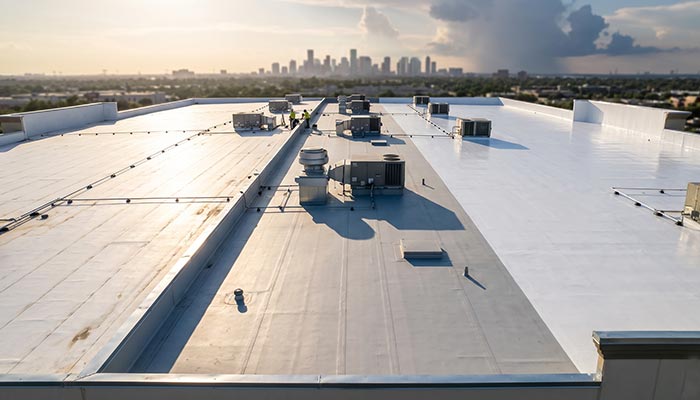
Gulf Coast heat, UV, humidity, and storms wear down flat roofs faster than in milder climates. Understanding these forces helps you choose a system that lasts.
Long summers expose roofs to intense sunlight for most of the year. UV rays slowly break down membrane surfaces. Meanwhile, daily heat cycling makes materials expand and contract. Over time, that movement stresses seams and flashing.
Moist air feeds algae and mildew on roof surfaces. In addition, heavy summer storms often leave ponding water on low-slope roofs. Our crews regularly find standing water near clogged drains across North Houston and Cypress. Left alone, it speeds up membrane wear.
Spring brings hail to Katy, Spring, and The Woodlands. Then hurricane season tests every edge detail and fastener. Wind uplift can peel back weak perimeters. For this reason, attachment method and edge metal matter as much as the membrane itself.
TPO roofing is a single-ply membrane known for reflectivity, welded seams, and value. It remains the most common choice for Houston commercial buildings.
Thermoplastic polyolefin reflects a large share of sunlight. As a result, it reduces heat gain inside the building. Its seams are hot-air welded, so they fuse into one watertight sheet. Many systems also carry UL Class A fire ratings and FM Approvals.
Key strengths include:
TPO does not tolerate grease and certain oils as well as PVC. Thinner membranes may also wear faster under constant heat. That said, choosing a thicker membrane and quality installation closes much of that gap.
TPO fits office parks, warehouses and flex space, retail centers, schools, and churches well. These buildings value energy savings and broad coverage at a practical investment.
PVC is a premium single-ply membrane with excellent chemical and moisture resistance. It shines where rooftop exposure goes beyond sun and rain.
Polyvinyl chloride resists grease, fats, and many chemicals. Because of this, it holds up well near restaurant kitchen exhaust. Its welded seams are also strong and long-lasting. Plus, PVC naturally resists fire and moisture intrusion.
PVC requires a higher upfront investment than TPO. Some older formulations can become brittle with age. Therefore, choosing a reputable manufacturer and proper installation matters.
PVC works best for restaurants, medical office buildings, and facilities with rooftop exhaust. It also suits properties where chemical exposure or grease runoff is a concern.
Roof coatings can add years to a roof that is aging but still sound. They are a restoration tool, not a fix for a failing roof.
Silicone restoration seals the surface with a seamless, reflective layer. It resists ponding water and UV well. In addition, TPO roof coatings can renew reflectivity and seal minor seam wear.
Consider a coating when:
Coatings cannot fix saturated insulation or widespread seam failure. Instead, those conditions usually call for replacement. A proper inspection prevents you from coating over hidden problems.
Each option balances upfront investment, durability, and maintenance differently. Here’s how they compare for Houston conditions.
Your final TPO roof cost in Houston depends on roof conditions and system design, not just square footage. Several factors drive the scope.
Thicker membranes resist heat and punctures better. However, they require a larger initial investment. In Houston, many owners choose heavier membranes for longer service life.
Mechanically attached systems use fasteners and plates. Fully adhered systems bond the membrane with adhesive. Fully adhered roofs often perform better against wind uplift but involve more labor.
Polyiso insulation improves energy performance and meets code requirements. A cover board adds hail and foot-traffic protection. Both influence the overall commercial TPO roof replacement cost in Houston.
Removing the old roof reveals deck damage and wet insulation. Meanwhile, a recover may be allowed if the existing roof is dry and code permits it. An inspection determines which path fits your building.
These same factors shape TPO roof installation cost across Harris County.
Not every leak means a new roof. The right choice depends on how widespread the damage is and whether insulation is wet.
Hail damage on a TPO roof often hides from ground view. Bruised membrane and fractured cover board may not leak right away. So schedule a professional inspection soon after any significant storm. Photos and documentation also support insurance conversations.
A maintenance plan is the simplest way to lower lifetime roofing costs. Small fixes today prevent large repairs later.
Most major roof failures start as small, ignored problems. Regular roof maintenance repair catches them early. As a result, you protect warranties, tenants, and interior assets.
Choosing the right system depends on how your building is used. Here’s a practical starting point:
Marlin Construction LLC has served Texas property owners since 2004. Our in-house crews have installed more than 5,000,000 square feet of TPO and PVC roofing.
We have also earned the Versico Gold Medal Quality Award eight years in a row. That recognition reflects consistent installation quality.
From our office in North Houston, we serve Spring, The Woodlands, League City, and nearby Harris County communities. Emergency service is available 24/7 when leaks can’t wait.

7 Signs Your Houston Commercial Roof Needs a Coating (Not a Replacement)

TPO vs PVC vs silicone coating: Which flat roof costs less long-term in Houston?

Storm-damaged flat roof? Houston commercial roof repair guide for 2026–2027

How to choose a TPO roof coating contractor in Houston: 10 questions to ask before you sign

TPO roof replacement in Houston, TX: 2026 cost, process and warranty guide

TPO Roof Repair vs. Replacement: 7 Signs Your Houston Commercial Roof Needs Help

TPO Roofing Cost in The Woodlands, TX (2026): What Commercial Property Owners Actually Pay
Both perform well in Houston humidity and UV when installed correctly. PVC resists grease, chemicals, and moisture slightly better, so it suits restaurants and medical buildings. TPO roofing offers strong UV reflectivity with a lower upfront investment. That makes it the practical choice for most offices, warehouses, and retail centers.
Heat, humidity, and storm risk all shape TPO roof cost in Houston. Wind uplift rules may call for extra fasteners or a fully adhered system. Wet insulation found during tear-off can also add scope. Because of this, an on-site inspection gives you the clearest picture before any TPO roof replacement begins.
Yes, if the membrane and insulation are still mostly dry and sound. TPO roof coatings seal aging seams, restore reflectivity, and delay full replacement. However, a coating cannot fix saturated insulation or widespread failure. An infrared moisture scan helps confirm whether restoration is a smart choice for your building.
Look for bruised or cracked membrane, dented metal edges, and new leaks after a storm. Hail damage on a TPO roof is often hard to see from the ground. For that reason, schedule a professional inspection soon after a hail event. Photos and a written report also help support any insurance claim you file.
Yes. Marlin provides TPO repair in South Houston, Pasadena, and across Harris County. Crews handle seam failures, punctures, flashing leaks, and storm damage. In addition, emergency service is available around the clock when a leak threatens tenants, inventory, or equipment. Call (713) 444-5202 to schedule an inspection.
A properly designed TPO roof performs well during hurricane season. The key is meeting wind uplift requirements with the right attachment method and edge details. Fully adhered systems and secure perimeter metal reduce blow-off risk. Coastal areas like League City may also need Texas Department of Insurance windstorm compliance.
PVC is usually the stronger choice for restaurants. It resists grease and animal fats from kitchen exhaust, which can soften TPO over time. That said, TPO can work well with a grease containment system near vents. Regular roof maintenance and repair visits also keep exhaust areas clean and free of leaks.
Plan on two inspections each year, ideally in spring and fall. Also schedule a check after any major hail or wind event. These visits catch open seams, clogged drains, and ponding water early. As a result, small TPO roof repair jobs in Houston stay small instead of turning into serious interior damage.
Yes. A white TPO roof reflects much of the sun’s heat away from your building. This cool roof effect reduces heat gain and eases the load on air conditioning. Over a long Houston summer, those energy savings add up. Clean the surface periodically, because dirt and algae reduce reflectivity over time.
Repair makes sense when damage is limited, and the insulation is dry. Replacement is wiser when leaks keep returning, seams fail widely, or insulation is saturated. A moisture survey shows exactly which areas are wet. With that data, you can compare TPO roof repair and TPO roof replacement options with confidence.
TPO, PVC, and silicone coatings each have a place on Houston rooftops. TPO roofing delivers dependable value for most commercial buildings. PVC protects properties with grease or chemical exposure. Meanwhile, coatings help sound roofs last longer with minimal disruption.
The smartest choice starts with an honest look at your roof’s condition. Marlin can help with TPO roof repair in Houston, TPO roof coatings, or a full TPO roof replacement.
Schedule a free roof inspection and estimate today. Call (713) 444-5202 to speak with our team. We serve Houston, Spring, The Woodlands, League City, and surrounding Harris County communities.










10403 Kansack Lane
Houston, TX 77086
Call: (713) 444-5202
Hours of Operation
Monday – Saturday
7:00am – 6:00pm
Sunday – Closed
