
Yes, a properly designed TPO roof can withstand hurricane-force winds in Houston. However, survival depends on the full assembly, not just the membrane. The attachment method, FM-rated components, and edge metal determine the outcome. For owners across Harris County, that difference shows up every hurricane season. As a TPO roofing company in Houston, Marlin Construction LLC sees one pattern after major storms. Roofs usually fail at the edges and corners first.
This guide explains TPO roofing performance in plain language. It also covers the updated Texas windstorm requirements and how roof warranties treat wind damage. Along the way, you’ll learn when commercial roof repair Houston owners need is urgent. Whether you manage commercial roofing in Houston TX, or a single HOA clubhouse, the goal stays simple. You want a roof that stays attached. That is what any reliable Houston roofing company should help you achieve.
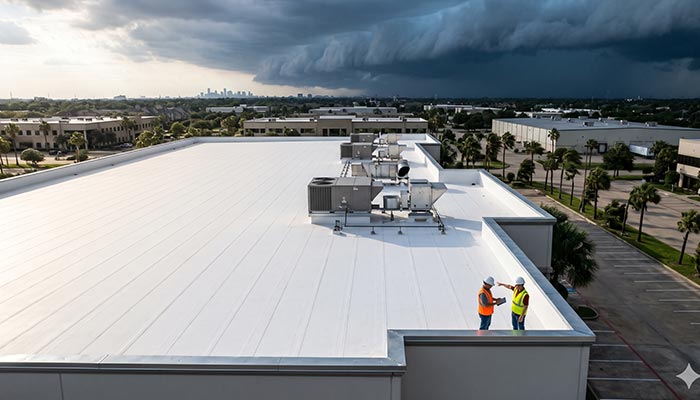
A TPO roof can handle hurricane-force winds when it is engineered for your building’s design wind pressures. Hurricane-force winds begin at 74 mph, yet the real threat is uplift, not raw speed.
TPO is a single-ply thermoplastic membrane. Its seams are heat-welded, so they fuse into one continuous sheet. As a result, well-welded seams are often stronger than the membrane itself.
Still, the membrane is only one layer. Underneath sit the deck, insulation, fasteners, and cover board. Each one must hold under load.
Storms like Hurricane Beryl and the May 2024 derecho reminded Houston owners of a hard truth. Wind damage often starts small, then spreads fast.
Wind uplift is the upward suction force created when wind flows over a roof. Air moving across the surface lowers pressure above the roof. Meanwhile, air inside the building pushes upward.
That combination tries to peel the roof off the deck. Consequently, every fastener and adhesive bond carries part of the load.
Uplift pressure is not equal across a roof. Building codes divide low-slope roofs into zones:
Because corners face the strongest suction, they need tighter fastener spacing. In addition, the perimeter edge metal must lock the membrane down.
Edge metal is the first line of defense. If it lifts, wind gets under the membrane. After that, peel-back can open a large section in minutes.
The industry standard for edge securement is ANSI/SPRI/FM 4435/ES-1. Ask whether your edge metal is tested to it.
Houston roofs face more than storms. Intense UV, heat, and Gulf Coast humidity slowly weaken materials.
For example, trapped moisture can soak insulation and corrode fasteners. Wet insulation also reduces fastener holding power. Therefore, a roof that passed testing years ago may now resist less uplift.
Hail season adds another layer of risk. Punctures and bruised insulation can create weak spots before hurricane season even starts.
An FM rating is an approval from FM Approvals showing a roof assembly passed standardized fire and wind testing. For single-ply membranes, the key standard is FM 4470.
The rating covers the complete system. That includes the deck type, insulation, fasteners, adhesives, and membrane. Swapping one component can void the approval.
FM wind ratings use a “1-XX” format. The number shows the uplift pressure, in pounds per square foot, the assembly resisted in testing.
Here is how to read common ratings:
FM guidance typically applies a safety factor to design pressures. As a result, the required rating is often higher than the calculated load.
Your required class depends on building height, exposure, location, and risk category. A qualified designer should calculate it for your site.
Each attachment method handles wind differently:
Membrane thickness also plays a role. Thicker sheets, such as 60 or 80 mil, generally resist punctures and wear better. However, thickness alone does not raise the uplift rating.
There is no single law titled the “2026 Texas Windstorm Code.” Instead, the phrase usually refers to updated windstorm building standards in effect for 2026.
Starting April 1, 2026, the Texas Department of Insurance (TDI) requires windstorm-certified work to follow the 2024 International Building Code or 2024 International Residential Code. Earlier projects followed the 2018 editions.
The 2024 IBC relies on ASCE 7 for wind load calculations. In practice, that means updated wind speed maps and roof zone pressures for new work.
Local jurisdictions may adopt their own code editions. Therefore, always confirm requirements with your city’s permit office.
In designated coastal areas, TDI runs a windstorm inspection program. A TDI-appointed engineer inspects the roof during installation.
Once the work complies, TDI issues a WPI-8 Certificate of Compliance. This certificate is often needed for TWIA insurance eligibility.
Missing inspections can create problems later. For instance, owners may struggle to obtain or renew windstorm coverage.
The Texas Windstorm Insurance Association (TWIA) covers only the designated catastrophe area. That area includes the 14 first-tier coastal counties.
Near Houston, it also includes parts of Harris County east of Highway 146. These cover areas inside the city limits of La Porte, Pasadena, Seabrook, Shore Acres, and Morgan’s Point.
Meanwhile, Galveston County cities such as League City fall inside the coastal tier. Most of Houston, Katy, Cypress, Spring and The Woodlands sit outside it.
Even outside TWIA zones, local codes still demand wind-resistant design. In short, every Houston-area roof needs proper uplift engineering.
Buildings with large, flat roofs and long open edges face the greatest uplift exposure. Height, openings and surrounding terrain also raise risk.
Common building types and their concerns include:
For example, a North Houston warehouse near 77086 often faces open-field exposure. Similarly, coastal properties in Pasadena and League City see stronger winds earlier in storms.
Regular maintenance & repair is the most practical way to protect a TPO roof. Atlantic hurricane season runs June 1 through November 30. Ideally, inspections happen in spring and again in fall.
Before peak storm activity, check these items:
Also, document roof condition with dated photos. That record helps with insurance claims later.
After a major wind event, inspect quickly but safely. Small openings can let water reach insulation within hours.
Prioritize repairs in this order:
Next, file insurance documentation promptly. Many policies set deadlines for reporting storm damage.
Roof coatings can extend the life of a sound TPO roof. They also improve UV reflectivity, which helps in Houston heat.
However, coatings do not add wind uplift resistance. If insulation is wet or fasteners have failed, a coating only hides the problem.
In those cases, a carefully planned TPO roof replacement in Houston is often the better choice. A replacement also allows an upgrade to a higher FM-rated assembly.
Roof warranties come in two main forms. Contractor warranties cover workmanship, while manufacturer warranties cover materials and, sometimes, the full system.
Most manufacturer warranties include a maximum wind speed limit. Damage above that limit is typically excluded. Some enhanced warranties cover higher peak gusts, but they require stricter installation specs.
Before signing, review these details:
Also, keep maintenance records. Missing them can void coverage when you need it most.
TPO roof cost in Houston depends on the scope and design requirements of your building. Every roof is different, so pricing must come from a site visit.
Key cost factors include:
Because of these variables, ask for a detailed written proposal. That way, you compare systems, not just totals.
The best TPO roofing company in Houston combines local storm experience with verified credentials. Look for proof, not promises.
Texas has no statewide roofing license. Therefore, verify these qualifications instead:
A reliable TPO roofing contractor in Houston should explain uplift zones in plain terms. If they cannot, keep looking.

Coat or replace? How Houston businesses add 10–20 years to rusting metal roofs

How to choose a commercial roofing contractor in Houston: 12 questions to ask (and red flags)

Aging TPO roof after storm season? How Houston building owners restore instead of replace

Coat or replace? 7 signs your Houston flat roof is a candidate for silicone restoration

Is your Houston TPO roof hurricane-ready? Wind uplift, FM ratings and the 2026 Texas windstorm code explained

7 Signs Your Houston Commercial Roof Needs a Coating (Not a Replacement)

TPO vs PVC vs silicone coating: Which flat roof costs less long-term in Houston?
Yes, a TPO roof can survive hurricane-force winds when the whole assembly is engineered for the site. That includes the correct FM-rated system, proper fastening in corners and perimeters, and tested edge metal. Most failures start at poorly secured edges, not the membrane. Your TPO roofing contractor should verify each detail.
An FM 1-90 rating means the tested roof assembly resisted 90 pounds per square foot of uplift pressure. The rating applies to the full system, including deck, insulation, fasteners, and membrane. Changing any component can void the approval. Therefore, ask your contractor to match the installed system to the FM listing.
You need one if your property sits in the TWIA-designated catastrophe area and you want TWIA coverage. Near Houston, that includes Galveston County cities like League City and parts of Harris County east of Highway 146. A TDI-appointed engineer inspects the work. Roof replacement in these areas should be planned around that inspection.
Plan on at least two inspections per year, ideally in spring and fall. In addition, schedule a check after any major wind, hail or tropical storm event. Regular maintenance & repair visits catch loose seams, open laps, and damaged flashing early. As a result, small issues rarely grow into costly interior leaks.
Roof coatings can extend service life and improve UV reflectivity on a sound TPO roof. However, coatings do not add wind uplift resistance. If fasteners, insulation, or edge metal are compromised, a coating only hides the problem. A proper inspection should confirm the assembly is secure before any coating is applied.
Some do, but coverage varies widely. Many manufacturer roof warranties include a maximum wind speed, and enhanced options may cover higher peak gusts. Damage above that limit is usually excluded. Before signing, review the wind speed clause, inspection requirements, and who handles claims with your Houston roofing company.
TPO roof cost in Houston depends on roof size, membrane thickness, attachment method, and insulation needs. Code requirements, FM approvals, and deck condition also play a role. Tear-off versus recover changes the scope, too. For an accurate figure, request a site inspection and written proposal from a licensed contractor.
Both can perform well when designed to the required uplift rating. Fully adhered systems resist membrane flutter because the sheet is bonded across the surface. Mechanically attached systems rely on fastener spacing, so corner and perimeter density is critical. Induction-welded systems offer a strong middle ground for many Houston buildings.
Texas has no statewide roofer license, so verify insurance, local references, and manufacturer certifications. Next, ask about experience with FM-rated assemblies and TDI windstorm inspections. A strong team for commercial roofing in Houston TX should explain uplift zones clearly. Finally, get warranty terms and scope in writing.
A TPO roof can stand up to Houston hurricanes when every layer works together. Edge metal, fastening patterns and FM-rated components matter more than the membrane alone.
Meanwhile, the 2026 shift to 2024 code editions raises the bar for new work. Coastal properties also need proper windstorm documentation for TWIA eligibility.
Regular maintenance & repair, smart use of roof coatings, and clear roof warranties protect your investment between storms. Understanding TPO roof cost in Houston also helps you plan upgrades without surprises.
Marlin Construction LLC is a TPO roofing company in Houston serving Harris County, Spring, The Woodlands, Katy, Cypress, Sugar Land, Pasadena and League City. Contact our team to schedule a roof inspection. We’ll assess wind readiness, explain your options and recommend the right next step for your building.








10403 Kansack Lane
Houston, TX 77086
Call: (713) 444-5202
Hours of Operation
Monday – Saturday
7:00am – 6:00pm
Sunday – Closed
